
What Is Abstract Art? Meaning, History, Styles, and How to Understand It
Abstract art is more than a style that avoids realistic representation. It is a way of communicating emotion, movement, and perception through color, shape, texture, and form.
Abstract art was invented in the early 20th century, specifically between 1906 and 1910. Swedish artist Hilma af Klint created what are considered the first truly abstract paintings in 1906, while Russian painter Wassily Kandinsky is credited with the first widely recognized abstract works in 1910.

Primordial Chaos, No. 16, 1906–07 by Hilma af Klint
To understand the context of abstract art, I love the belief by Wassily Kandinsky that colors and abstract forms could affect human emotions in the same way music does, allowing paintings to express inner feelings and spiritual ideas without relying on recognizable subjects.
This approach transformed modern art by shifting the focus from physical reality to emotional and psychological experience.

Wassily Kandinsky - Composition VII, 1913, oil on canvas
What Defines Abstract Art?
What defines abstract art is the reduction or transformation of visual reality into essential artistic elements such as composition, movement, spatial balance, color interaction, and form.
Rather than focusing on accurate depiction, abstract artists, like myself, reorganize visual information to emphasize mood, rhythm, symbolism, or psychological response.
For example, one of my latest paintings (image below), Soft Power, represents a visual meditation, a magnetic field, a soft force of abundance and presence.

Agnese Repule - Soft Power (acrylic on canvas) 100x120, 2025
Some works maintain partial references to real-world subjects, while others remove recognizable imagery entirely to create purely non-objective compositions.
This flexibility allows abstract art to exist across multiple movements and techniques, from the geometric precision of Piet Mondrian to the spontaneous gestural energy of Jackson Pollock.
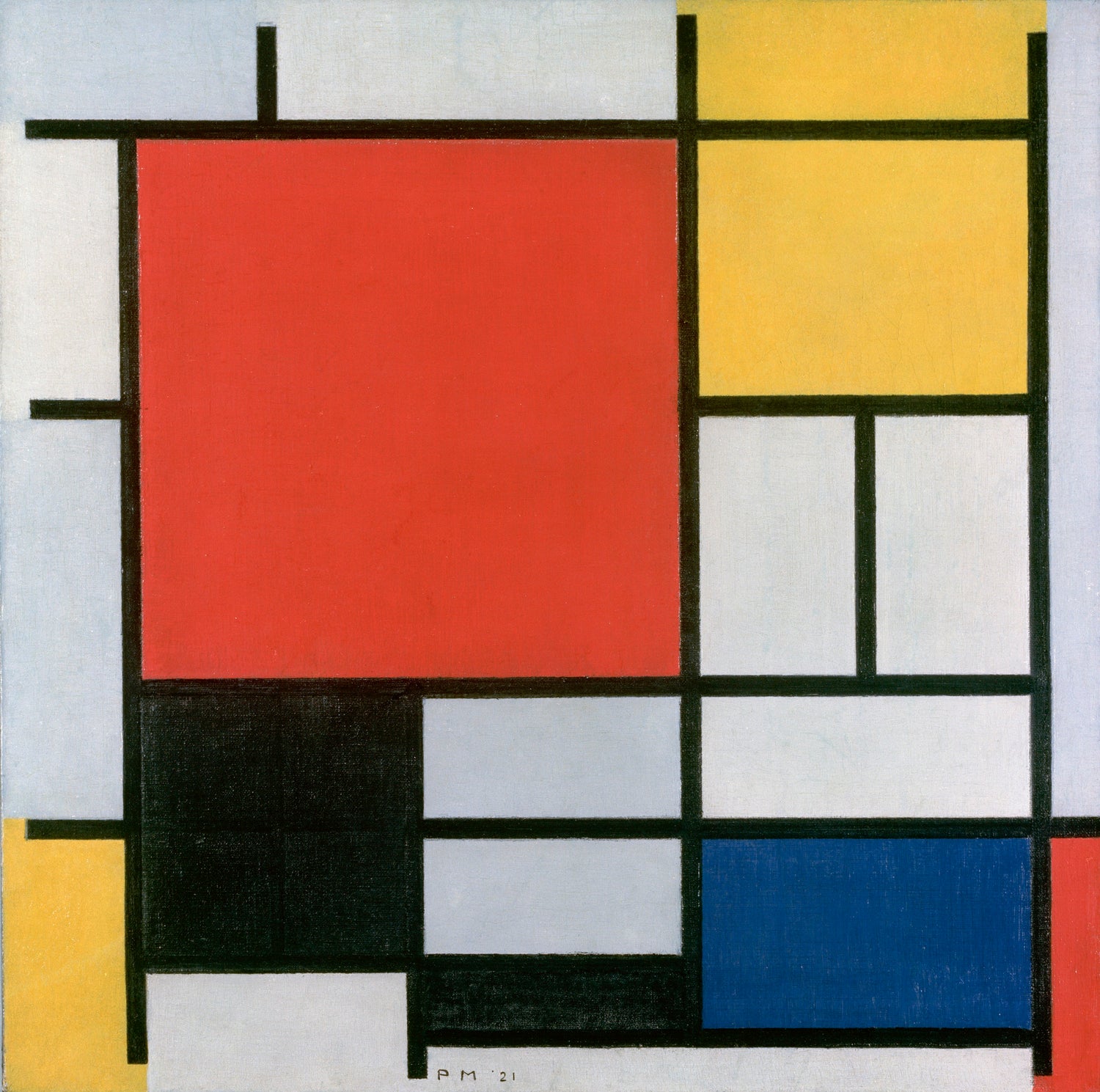
Piet Mondrian - Composition in Red, Yellow, Blue and Black, 1921
Jackson Pollock - Untitled, Gouache and pastel on paper, ca. 1946
Abstract vs Representational Art
Representational art shows the world as it is (or close to it), while abstract art departs from that, using form, color, and shape to express ideas or emotions independent of visible reality.
It's important to remember that representational (or realistic) art often contains partial abstraction.
An example of representational art is Mona Lisa by Leonardo da Vinci (c. 1503–1519). Mona Lisa is one of the most famous representational paintings ever made.
It depicts a real woman (Lisa del Giocondo) with extraordinary realism - lifelike skin tones, perspective, and subtle expression. The subject is instantly recognizable.
Another example of representational art is The Starry Night by Vincent van Gogh (1889). A slightly stylized but still representational work. In this painting, you can clearly see a night sky, a village, and rolling hills. Van Gogh distorts reality somewhat (swirling clouds, exaggerated stars), making it a bridge between representational and partially abstract art.

Why Does Representational Art Matter When Discussing Abstract Art?
Abstract art didn't appear out of nowhere, it emerged as a deliberate departure from representational art.
Western art was dominantly representational for centuries, from ancient cave paintings to the Renaissance masters, like Leonardo da Vinci or Raphael (Raffaello Sanzio).
Abstract art was a radical 19th–20th century break from that long tradition. Without mentioning representational art, we would lose the whole story of why abstract art was so revolutionary and controversial when it appeared.
What Are the Key Characteristics and Types of Abstract Art?
Abstract art moves away from realistically representing the physical world. Instead of focusing on recognizable subjects or literal scenes, it uses color, shape, texture, line, and composition to create visual experiences driven by emotion, movement, and interpretation.
Rather than telling viewers exactly what to see, abstract art encourages personal meaning and emotional connection, allowing each person to experience the artwork differently through its forms, energy, and atmosphere.
The Main Characteristics of Abstract Art
Non-Representational Art Theory
Non-Representational Art, also known as non-objective art, completely abandons trying to mimic nature or recognizable objects, figures, or real-world scenes.
Even when inspired by real-world objects, the result is heavily simplified, fragmented, or completely detached from literal representation.
Non-representational art starts and ends with shapes and colors, having no basis in the physical world.
Artists of non-representational art are Wassily Kandinsky, Piet Mondrian, and Kazimir Malevich.
Emphasis on Color, Shape, and Composition
Abstract artists focus on the essential visual elements of art, including color, texture, line, shape, form, and balance, rather than accurately depicting recognizable subjects or scenes from reality.
Emotional and Conceptual Expression
Abstract art is often created to express emotions, energy, ideas, or states of mind. Instead of representing the external world, artists use abstraction to communicate atmosphere, movement, spirituality, tension, or personal interpretation.
Spontaneous and Intuitive Creation
Many abstract paintings are created through expressive brushstrokes, layered textures, gestural marks, and experimental techniques that give the artwork a sense of freedom, movement, and spontaneity.
Open to Personal Interpretation
Because abstract art does not present a fixed narrative or literal meaning, viewers are encouraged to interpret the artwork through their own emotions, experiences, imagination, and perspective, making every interaction unique.
Understanding Abstract Art and Core Principles
Abstract art turns its back on objective reality. There's no recognizable subject to anchor the viewer — no landscape, no face, no object to name. Instead, the work communicates entirely through color, form, texture, composition, and contrast.
These aren't decorative choices. They're the only tools available. When a painting has nothing literal to say, every visual decision carries weight — the temperature of a hue, the tension between shapes, the rhythm of a brushstroke. Abstract art lives or dies by how well these five elements work together to produce something the viewer feels before they understand it.
That's what makes it structurally demanding. Without a subject to do the heavy lifting, the artist must build emotion, hierarchy, and movement from scratch — using pure visual relationships as the language.
The History and Evolution of Abstract Expressionism
Abstract Expressionism is an abstract art movement that emerged in New York in the 1940s, during and after World War II.
There was no single founder. Instead, the movement developed through a group of artists including Jackson Pollock, Willem de Kooning, Mark Rothko and Barnett Newman, who moved away from traditional representation and explored emotion, intuition and the unconscious through abstract art.
How Abstract Art Evolved
Abstract art did not appear overnight. Several modern art movements gradually challenged traditional ideas about color, form, perspective and representation.
Artists such as Henri Matisse used intense and expressive colors rather than reproducing the natural colors of their subjects. Color increasingly became a means of expression in its own right.
Pablo Picasso and Georges Braque fragmented subjects into geometric forms and presented multiple viewpoints within the same composition. Art no longer had to reproduce exactly what the eye could see.
During the 1910s, artists including Wassily Kandinsky, Kazimir Malevich and Piet Mondrian explored paintings in which color, line, geometry and composition could exist independently from recognizable subjects.
Emerging in New York in the 1940s, artists including Jackson Pollock, Willem de Kooning, Mark Rothko and Barnett Newman used gesture, movement, color, texture and scale as forms of expression. The painting itself became the experience.
The movement developed into two major approaches. Action Painting, associated with artists such as Jackson Pollock and Willem de Kooning, emphasized spontaneous gestures, movement and the physical process of painting.
Color Field Painting, associated with Mark Rothko and Barnett Newman, used large areas of color to create emotional and immersive experiences.
Large canvases, expressive gestures, color, texture and experimentation became defining characteristics of Abstract Expressionism. Rather than depicting recognizable subjects, artists used movement, materials and color as forms of expression.
Abstract Expressionism had a major influence on the development of modern and contemporary abstract art. It helped establish abstraction as a powerful way for artists to communicate ideas, emotions and experiences without directly representing the visible world.
Famous Abstract Artists and Their Iconic Masterpieces
The history of abstract art has been shaped by artists who challenged traditional ideas about color, form, perspective and artistic expression. From the first experiments with pure abstraction to Abstract Expressionism, these artists helped redefine what a painting could be.
Wassily Kandinsky
Wassily Kandinsky is widely regarded as one of the pioneers of abstract art. He believed that colors and forms could communicate emotion without representing recognizable objects. His work became increasingly abstract during the early 20th century and helped establish abstraction as an independent form of artistic expression.
Iconic work: Composition VIII (1923)
Piet Mondrian
Piet Mondrian reduced visual compositions to their most fundamental elements: straight lines, geometric shapes and primary colors. His distinctive approach became closely associated with the De Stijl movement and influenced art, architecture, graphic design and fashion.
Iconic work: Composition with Red, Blue and Yellow (1930)
Kazimir Malevich
Kazimir Malevich developed Suprematism, an abstract movement based on simple geometric forms and pure artistic feeling. His radical reduction of painting challenged the idea that art needed to represent objects or scenes from the physical world.
Iconic work: Black Square (1915)
Jackson Pollock
Jackson Pollock became one of the most recognizable figures of Abstract Expressionism and Action Painting. His drip technique transformed painting into a physical process involving movement, rhythm and controlled spontaneity.
Iconic work: Autumn Rhythm (Number 30) (1950)
Mark Rothko
Mark Rothko became known for large paintings composed of luminous fields of color. Associated with Color Field Painting, Rothko used relationships between colors to create immersive works intended to evoke emotional and contemplative responses.

Iconic work: No. 61 (Rust and Blue) (1953)
Willem de Kooning
Willem de Kooning combined abstraction with traces of recognizable human forms. His energetic brushwork and layered compositions made him one of the central figures of Abstract Expressionism.
Iconic work: Woman I (1950–1952)
Together, these artists demonstrate how diverse abstract art can be. Kandinsky explored the emotional possibilities of color and form, Mondrian and Malevich moved toward geometric abstraction, while Pollock, Rothko and de Kooning helped transform abstraction into a more physical, emotional and expressive experi
Different Styles and Techniques in Non-Representational Art
Non-representational art is art that does not depict recognizable people, objects, landscapes, or scenes from the real world. Instead, the artwork is built entirely from visual elements such as color, line, shape, texture, form, space, and composition.
Non-representational art is closely connected to abstract art, but the terms are not exactly the same.
Abstract art can begin with something recognizable and simplify, distort, fragment, or transform it. Cubism, for example, breaks recognizable subjects into geometric forms, while Fauvism transforms natural colors into expressive, intensified color. These early modern movements helped artists move away from realistic representation and toward abstraction.
Non-representational art goes further. Rather than transforming a recognizable subject, it does not need to represent an external subject at all. The colors, shapes, lines, gestures, and relationships within the composition become the artwork itself.
Key Styles of Non-Representational Art
Geometric Abstraction: Uses geometric shapes, straight lines, grids, and carefully structured compositions. Artists explore relationships between color, proportion, form, and space rather than depicting recognizable subjects. Piet Mondrian and Kazimir Malevich are important figures associated with this development.
Action Painting: A major approach within Abstract Expressionism that emphasizes movement, spontaneity, and the physical process of creating art. Artists may drip, splash, pour, or rapidly apply paint across the canvas. Jackson Pollock became one of the best-known artists associated with this approach.
Color Field Painting: Another important development associated with Abstract Expressionism. It uses large areas of color to create immersive, atmospheric, or emotional experiences. Mark Rothko and Barnett Newman are closely associated with Color Field painting.
Minimalism: Emerging prominently in the 1960s, Minimalism reduced artworks to essential forms, colors, materials, and structures. Artists often used simple geometric forms and industrial materials while rejecting expressive gesture and traditional narrative.
Lyrical Abstraction: Emphasizes spontaneous movement, fluid brushwork, expressive color, and organic forms. Unlike the precision of geometric abstraction, Lyrical Abstraction tends to create a freer and more emotionally expressive visual experience.
Common Techniques in Non-Representational Art
Dripping and Pouring: Paint is dripped, splashed, poured, or allowed to flow directly across the surface. The movement and behavior of the paint become part of the composition.
Gestural Mark-Making: Broad brushstrokes, scratches, lines, and energetic marks are created using brushes, palette knives, sticks, or other tools. This technique became particularly important in Abstract Expressionism and Action Painting.
Layering and Scraping: Artists build multiple layers of paint and then scrape, scratch, or partially remove them. Revealing earlier layers can create texture, depth, movement, and visual complexity.
Grids and Serial Formats: Shapes, lines, or blocks of color are repeated according to structured systems. This approach is particularly associated with geometric abstraction and later Minimalist practices.
Abstract Art vs. Non-Representational Art
The easiest way to understand the difference is to look at whether the artwork has a recognizable starting point.
Abstract art may represent something from reality in a simplified, fragmented, distorted, or transformed way. Non-representational art does not need to represent anything from the visible world at all.
For example, a Cubist portrait is abstract because the human figure has been fragmented and reconstructed, but the subject is still recognizable as a person. A composition consisting entirely of independent colors, lines, and geometric forms may be considered non-representational because there is no external subject being depicted.
This distinction also explains the development of modern abstraction. Fauvism and Cubism helped loosen art from realistic representation in the early 20th century. Geometric abstraction pushed further toward independent forms and colors, while Abstract Expressionism later made gesture, color, scale, and the act of painting itself central to the artwork.
In this sense, non-representational art is not a single art movement. It is a broader approach found across movements and styles including Geometric Abstraction, Abstract Expressionism, Action Painting, Color Field Painting, Lyrical Abstraction, and Minimalism.
How to Appreciate and Interpret Abstract Paintings in 2026
You do not need to understand exactly what an abstract painting “means” to appreciate it. Unlike representational art, abstract art may not give you a recognizable person, object, or landscape to identify. Instead, it asks you to pay attention to color, form, line, texture, movement, scale, and the emotions or associations they create.
The key is to spend less time asking “What is this supposed to be?” and more time asking “What is happening in this painting?”
1. Start With What You See
Before reading the title, artist statement, or gallery description, look at the painting itself.
What catches your attention first? Notice the dominant colors, shapes, lines, textures, empty spaces, repeated forms, and contrasts. A painting made from sharp geometric forms can create a very different experience from one filled with loose brushstrokes and layers of flowing color.
You do not need to assign meaning to these elements immediately. Simply noticing them is the first step toward understanding how the painting works.
2. Notice How the Painting Makes You Feel
Abstract paintings can communicate through atmosphere and sensation rather than recognizable imagery.
A large field of dark color might feel quiet, heavy, intimate, or unsettling. Rapid gestural marks might create a sense of movement or tension. Soft transitions between colors may feel meditative.
There is no requirement for every viewer to experience the same emotion. Your reaction is part of encountering the artwork, but it is not necessarily the same thing as the artist's intended meaning.
3. Look at How the Artist Used the Materials
In abstract art, how a painting was made can be as important as what appears on the canvas.
Look for visible brushstrokes, drips, scraped areas, thick layers of paint, stains, repeated marks, exposed canvas, or carefully constructed geometric forms.
For example, the physical gestures visible in Action Painting are central to understanding the work, while Color Field Painting often shifts attention toward large expanses of color and the experience of standing in front of them.
4. Consider the Scale and Space
Abstract paintings can change dramatically when experienced in person.
A composition that looks relatively simple on a phone screen may become immersive when it occupies an entire wall. Large-scale works can surround your field of vision, while smaller paintings may encourage a more intimate kind of looking.
This is one reason seeing abstract art in galleries and museums can produce a very different experience from seeing the same artwork online.
5. Learn the Context After Looking
Once you have formed your own first impression, learn about the artist and the period in which the painting was created.
Was the artist connected to Cubism, Geometric Abstraction, Abstract Expressionism, Action Painting, Color Field Painting, Minimalism, or another movement? What were artists of that period reacting against or trying to explore?
Context can reveal why something that looks simple today was radical when it was created.
For example, Cubism challenged traditional perspective by showing subjects from multiple viewpoints. Abstract Expressionists later moved even further from conventional representation, making gesture, scale, material, and color central parts of the artwork.
6. Do Not Search for a Hidden Object in Every Painting
One of the most common mistakes when looking at abstract art is trying to turn every shape into something recognizable.
You might see a face, landscape, figure, or familiar object, and those associations can be interesting. But some abstract paintings are deliberately non-representational, meaning they were not created to depict objects from the visible world.
Sometimes a line is functioning as a line, a field of red as color, and a geometric shape as form.
7. Give the Painting More Than a Few Seconds
Abstract art often rewards slower looking.
Move closer and notice the surface. Step back and look at the entire composition. Pay attention to where your eye moves and which elements become more noticeable over time.
Then ask yourself:
What did I notice first? What changed after I looked longer? Which part holds my attention? How do the colors and forms interact? Does knowing the artist's context change what I see?
You still may not like the painting, and appreciation does not require liking everything you see.
Ultimately, interpreting abstract art is not about finding one secret meaning or guessing the correct answer. It is about understanding how visual elements, artistic choices, historical context, and your own perception work together to create the experience of the painting.